The General Situation of Pipelines in China

In the municipal engineering of cities and towns, the pipeline is an extremely important part. Moreover, apipeline is also called the underground lifeline of the city. It is not only responsible for water supply and drainage in cities and towns, supplyingvarious energy sources such as heating, natural gas, and petroleumfor petrolstations, but also uses its water conservancy functions to irrigate farmland and forests. It can be seen that pipelines are not only widely used in municipal engineering, but also in various water conservancy facilities, engineering and mechanicalequipment.
Pipes can be generally classified into metal pipes and non-metal pipes according to their materials, and non-metal pipes can be further classified into organicpipesand inorganic pipes. The length from the bottom of the pipeline to the ground is called the buried depth of the pipeline. The soil from the upper part of the pipe diameter to the ground is the earthingof the pipe. It is stipulated that in frozen areas, the depth of covering soil on the top of thepipeshall not be less than 0.15m below the soil freezing lineinDesignSpecificationsof Outdoor Drainage.Under the roadway, the thickness of the covering earth should not be smaller than 0.6m for pipes except for the road surface. For a sloped pipeline, the slope of the ground is smaller than thatof the pipeline, and the actual buried depth of the pipeline is required to be greater; the corresponding construction period is longer and the cost isalso higher.Therefore, when the pipeline'scovering soil is dry and stable, the burial depth should not be too deep, generally not more than 7to 8meters.When the pipeline'scovering soil is mostly water, quicksand, and limestone, the burial depth should not exceed 5meters.
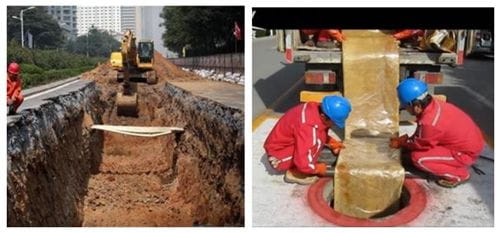
According to the requirements of Design Specifications of Outdoor Drainage,the pipelines that use gravity to discharge sewage should be designed asthe non-full flow.Table 1-1 shows the maximum fullness. For rainwater pipes and confluence pipes, their maximum fullness should be designed according to full flow. There are also specifications for the design of the drainage flow rate of drainage pipes. The maximum flow rate of metal pipesis less than 10m/s, and thatof non-metal pipesis less than 5m/s. However, if the experimental results meet the conditions, the maximum flow rate of non-metal pipescan beappropriately increased. Accordingly, in order to make the drainage more smooth and prevent blocking, there are also requirements for the minimum flow rate of the drainage pipe. The minimum flow rate of confluence pipes and rain water pipesmust be greater than 0.75m/s. The diameter of the drainage pipe and its corresponding design minimum slope are shown in Table 1-2.
Table 1-1 Maximum design fullness
Pipes can be generally classified into metal pipes and non-metal pipes according to their materials, and non-metal pipes can be further classified into organicpipesand inorganic pipes. The length from the bottom of the pipeline to the ground is called the buried depth of the pipeline. The soil from the upper part of the pipe diameter to the ground is the earthingof the pipe. It is stipulated that in frozen areas, the depth of covering soil on the top of thepipeshall not be less than 0.15m below the soil freezing lineinDesignSpecificationsof Outdoor Drainage.Under the roadway, the thickness of the covering earth should not be smaller than 0.6m for pipes except for the road surface. For a sloped pipeline, the slope of the ground is smaller than thatof the pipeline, and the actual buried depth of the pipeline is required to be greater; the corresponding construction period is longer and the cost isalso higher.Therefore, when the pipeline'scovering soil is dry and stable, the burial depth should not be too deep, generally not more than 7to 8meters.When the pipeline'scovering soil is mostly water, quicksand, and limestone, the burial depth should not exceed 5meters.
According to the requirements of Design Specifications of Outdoor Drainage,the pipelines that use gravity to discharge sewage should be designed asthe non-full flow.Table 1-1 shows the maximum fullness. For rainwater pipes and confluence pipes, their maximum fullness should be designed according to full flow. There are also specifications for the design of the drainage flow rate of drainage pipes. The maximum flow rate of metal pipesis less than 10m/s, and thatof non-metal pipesis less than 5m/s. However, if the experimental results meet the conditions, the maximum flow rate of non-metal pipescan beappropriately increased. Accordingly, in order to make the drainage more smooth and prevent blocking, there are also requirements for the minimum flow rate of the drainage pipe. The minimum flow rate of confluence pipes and rain water pipesmust be greater than 0.75m/s. The diameter of the drainage pipe and its corresponding design minimum slope are shown in Table 1-2.
Table 1-1 Maximum design fullness
| Pipe diameters(mm) | Maximum design fullness |
| 200to 300 | 0.55 |
| 350to 450 | 0.65 |
| 500to 900 | 0.7 |
| Greater than and equal to 1000 | 0.75 |
Table 1-2 Minimum pipe diametersand corresponding minimum slopes
| Typesof pipes | Pipe diameters(mm) | Minimum slopes |
| Sewage pipes | Greater than and equal to 300 | 0.002for plastic tubes and 0.003 other tubes |
| Rainwater pipes and confluence pipes | Greater than and equal to 300 | 0.002for plastic tubes and 0.003 other tubes |
| Rainwater pipe ends | Greater than and equal to 200 | 0.01 |
Since the water supply methods are all pressurized, there are no specific requirements for the fullness, maximum and minimum flow rates and design slopeof the water supply pipes. In addition, the minimum pipe diameter should be greater than 100mmfor the water supply pipes that also have the function of fire-fighting water supply, and the spacing of outdoor fire hydrants should not exceed 120m.